
Why change how we vote? Many reasons!
The sections below outline the case for change, starting with the ways in which your vote doesn’t fully matter under our current First-Past-the-Post voting system, regardless of whether or not you helped elect someone. The root of the problem is that FPTP doesn’t treat voters equally, and the biggest obstacle to change is the self-interest of politicians themselves. The strongest democracies – the ones that consistently outperform Canada – use more inclusive voting systems than we do, so check out the better ways to vote that they use.
You can read this story at whatever level of detail you want – scan through the overview slides, check out the larger infographics, or dive down into the details – it’s your choice!
- Overview
- Infographic
- In-Depth
- Why Change?
- Voter Inequality
- Obstacles
- Stronger Democracy
- Better Ways to Vote


- Voter Inequality
- Voter Inequality
- Obstacles
- Stronger Democracy
- Better Ways to Vote


- Why Change?
- Voter Inequality
- Obstacles
- Stronger Democracy
- Better Ways to Vote
You voted. So now you’re well represented, right?
Many of us assume that’s what happens. You show up, you mark your ballot, and the result reflects the voters’ will. That’s definitely what should happen.
But the way our voting system works in practice is a different story — one that affects every voter, regardless of which party they support or whether the candidate they voted for won or lost.
This isn’t about any particular election or any particular party. It’s about the mechanics of the First Past the Post voting system that Canada uses to translate votes into seats, and about the glaring gap between what we expect our voting system to do and what it actually does.
The sections below walk through the three ways your vote might have turned out, and what each outcome really means for you and for the rest of us. Click on the heading that best describes what happened the last time you voted:
What happened the last time you voted?
That sucks, eh? We feel for you. In a First Past the Post election, only one candidate wins each riding — and winning by one vote is the same as winning by thousands. Every vote cast for every other candidate effectively counts for nothing. Your vote ends up with no seat, no share of power, and no influence over what happens next. It’s as if you hadn’t voted.
Only A “Small Party” Problem? You might think: “that only happens to voters who support fringe candidates and small parties – I’m too smart to waste my vote that way – it’s obvious that that’s a waste of effort”. But that’s not the case. In every BC and federal election, huge numbers of voters for major party candidates — Conservative voters in Vancouver, NDP voters in the Interior, Liberal votes across rural Canada — vote for candidates who finish second or third in their riding. This isn’t a small-party problem. It affects supporters of every party, in every region, in every election. In fact, in the 2019 federal election, the largest group of disappointed voters were Conservatives — nearly 2.5 million of them voted for a losing Conservative candidate — more than any other party.
Unrepresented Voters Everywhere: The result is a sea of disappointed voters and silenced voices. In some parts of BC, a significant share of voters support parties that win few or no seats in their region. Those voters have no representative in the legislature who reflects their views — not because their numbers are small, but because their votes are spread across a number of ridings rather than concentrated enough to be the locally biggest group.
Strategic Voting (Voting for the “Lesser Evil”): This also affects how people think before they even reach the voting booth. Many voters feel they can’t afford to vote honestly — if your preferred candidate has little chance of winning in your riding, voting for them feels like throwing your vote away. So you hold your nose and vote for the lesser of two evils instead. Larger parties encourage you to think of strategic voting as the savvy way to use your vote, but it’s actually a symptom of a warped system that penalizes sincere voting. Why shouldn’t you be free to vote your true political convictions?
Congrats! Opposition is Important: If your candidate won a seat, congratulations! You helped elect the candidate you wanted. If they’re part of the opposition, their job is genuinely important — scrutinizing government legislation, holding ministers to account, and making sure that views other than the government’s get heard in the chamber. All of that work is crucial to our democracy.
But here’s the catch: under First Past the Post, the opposition is almost always smaller than it should be.
Weak Opposition: Because of the way votes translate into seats, a second-place party that wins a third of the vote or more might end up with far fewer seats. In BC’s 2001 election, 42% of the voters chose someone other than a Liberal candidate, but only two non-Liberals were elected, and no party won formal status, so there was technically no opposition party at all. In just about every election, the opposition benches end up being way thinner than the actual distribution of public opinion warrants. That means less scrutiny of the government, fewer questions, less capacity to examine legislation in depth, and a government that faces less challenge than voters actually intended.
Wasted Efforts: Your preferred party also faces other significant challenges. It takes a ton of effort to put candidates up for election, especially in ridings where they have little hope of winning. It’s doubly hard because there’s no incentive to organize locally — who wants to join a perpetually losing and futile effort? This often leads to lower-quality candidates being recruited — everyone (including themselves) know that they’re sacrificial lambs — and no sustained party organization and activity between elections. This is largely a waste of time for everyone involved, rather than being an opportunity to energize our democracy at the grassroots level.
Limited Influence: And when a party wins a majority government — which First Past the Post can deliver on as little as 35–40% of the popular vote — the imbalance becomes stark. The government controls everything: the agenda, the committees, and the calendar. The opposition can speak, but it cannot compel. In those circumstances, a government that chooses to ignore its critics can do so almost entirely, not because public opinion supports that, but because the seat count does.
Trying Their Best, but Handicapped: Your representative is probably doing their best to do the job they were elected to do, but they’re forced by our voting system to do it with less backup, support, and resources than you and your fellow voters actually asked for with your votes.
Congratulations! This is the best-case scenario for you. Your candidate won, your party is in power, and the government is going to get on with doing everything you elected them to do. Politics is great, right? Or is it?
Even here, First Past the Post introduces problems that most winning voters never notice — until they do.
Governments are missing voices from the regions they don’t win. No party wins seats everywhere. A governing party with little or no representation from certain parts of the province or country has no one in its caucus or cabinet who really knows those communities — their economic realities, their local priorities, their particular concerns. Those regions are not just underrepresented in the legislature; they’re absent from the internal conversations where policy actually gets shaped.
Safe seats (and you) are taken for granted. If your riding reliably votes the same way every election, your party already knows it has your vote. It doesn’t need to earn it, and — because it knows it will keep it — it doesn’t need to maintain a serious presence in your community. Local party organizations in safe ridings are often skeletal. Candidates are sometimes recruited as an afterthought (“a doorpost could be elected in this riding if it had the right party label”). Your voice feeds back into the party machine only weakly, because the party has no structural reason to listen carefully to you. You are counted on, not courted.
Swing ridings get the attention — and the rewards. Because First Past the Post elections are decided in a relatively small number of competitive ridings, parties pour their resources, their leaders’ time, and their most attractive promises into those ridings. Infrastructure announcements, funding commitments, high-profile visits — these flow disproportionately to the ridings that actually determine outcomes. You see this dynamic writ large in the US presidential elections, where the candidates spend all their time in the half dozen swing states. If you don’t live in one of those ridings, you are propping up a system that is principally paying attention to someone other than you.
Even good politicians in vulnerable seats can be swept away. The cruelest irony of First Past the Post is that it can be bad for good politicians — particularly for capable, experienced representatives in swing ridings. A conscientious MP or MLA who has served their community well, worked hard, and maintained the trust of their own supporters can still lose their seat — not because they didn’t do their job, but simply because the broader political tide shifted and they happened to be standing in the most vulnerable place. For talented people considering a career in public service, this is a real deterrent to entering politics. And when a shift in the political mood sweeps out a bunch of incumbents in swing ridings, parties can suddenly lose some of their most seasoned and community-connected members, leaving them unnecessarily weakened.
Majority governments can stop listening — even to their own voters. When a party wins a majority, it holds 100% of the legislative power, even if it has the support of much less than a majority of the voting public. This means it doesn’t experience ongoing pressure even from its supporters to remain attentive or responsive — the math guarantees four years in office regardless. Governments may enter power with the best of intentions, but the insulation a majority provides is real, and it shows. Governments in this position tend to become distant, arrogant, and dismissive in ways that frustrate even the voters who supported them. The system doesn’t just allow this to happen — it actively creates the conditions that promote such behaviour.
Three possible outcomes for you. But regardless, the system falls short – both for you and for the rest of us.
Weakens Connections Between Voters’ Wishes & Outcome:
Whether your vote was wasted, whether your representative is fighting from the opposition benches with fewer allies than voters chose, or whether your party won power but governs without hearing from whole regions and communities or takes you for granted — the pattern is the same: First Past the Post consistently produces outcomes where the connection between what voters want and what governments do is weaker than it should be.
A Structural Flaw:
This is not a flaw that affects only one side of the political spectrum. It is not something that the right election result can fix. It is built into the structure of the system itself.
Erodes Democracy:
And the consequences go deeper than you might expect. It’s not just that your individual vote matters less — it’s that the distortions between how people vote and the representation that results warps public policy, reduces government accountability, and erodes the foundations of democratic trust in ways that affect all of us.
Inequality hurts us all.
Some people hear the discussion on the previous page and think: “So what? Every system has imperfections. Votes get wasted, politicians get complacent — that’s just how it goes.”
That response is understandable. But before we catalogue the practical consequences of our voting system’s shortcomings, it’s worth naming what kind of problem this actually is.
An unequal vote is a civil rights issue.
We no longer consider it acceptable to deny someone the right to vote. The historical exclusion of women, Indigenous peoples, and others from the franchise is now recognized as a profound injustice — not a minor procedural matter, not an unfortunate feature of the times, but a fundamental violation of the principle that citizens are political equals. We fixed it, because the old way became incompatible with our view of what democracy should mean.
The right to cast a ballot is not the same as the right to an equal vote. When a system routinely gives some voters meaningful influence over the outcome while others’ votes change nothing, we have a different form of the same underlying problem: not all citizens are being treated as political equals. The mechanism is different, but the principle is the same.
Our Charter Rights: This is not merely a philosophical argument. Section 3 of the Canadian Charter of Rights and Freedoms guarantees every citizen the right to vote — and the courts have held that this means considerably more than simply being permitted to mark a ballot:
- In the Saskatchewan Boundaries Reference (1991), the Supreme Court held that Section 3 protects not just the formal right to vote, but the right to effective representation and relative equality of voting power — the principle that no citizen’s vote should count for dramatically more or less than another’s.
- In Figueroa v. Canada (2003), the Court held that Section 3 also protects the right to meaningful participation in the electoral process — the ability to play a genuine role in shaping political power, not merely to go through the motions of casting a ballot.
First-Past-the-Post systematically produces outcomes where millions of votes influence nothing while a relative handful determine who governs – this inequity sits in tension with both of these principles. The consequences that follow are not just policy failures or political inconveniences. They are the practical expression of a civil rights gap that our own legal framework already recognizes — in principle, if not yet in practice.
All of the consequences described below — consequences for voters, for political parties and competition, for government policy, and for our democratic health — follow from the fundamentally unequal ways our FPTP voting system treats different groups of voters.
FPTP has negative consequences for:
The most immediate effects are felt by individual citizens — in how they vote, how they feel about voting, and how connected they feel to the government that results.
Satisfaction and legitimacy take a huge hit. Research consistently shows that voters in democracies that use more inclusive voting systems report higher satisfaction with democracy — even when their preferred party isn’t in government. This finding points to something important: what people want from democracy is not just to win, but to feel that the outcome was fair and that their voice counted for something. This willingness of people whose side lost to accept the result as legitimate and trust that the system is working is known as “loser’s consent”. FPTP erodes this consent, because losing voters can see clearly that the outcome doesn’t reflect the actual distribution of political views in the country. A government that half the country considers illegitimate is governing on a weakened foundation — and that fragility affects everyone, not just the losers.
Sincere voting is penalized. Voters who support parties unlikely to win in their riding face a dilemma that no-one should have to: vote sincerely and waste your vote, or vote “strategically” and try to elect someone you only consider the “lesser evil” — not someone you actually support. The evidence shows that this dynamic suppresses both turnout and authentic political expression. Voters in this position vote less often than others, and when they do vote, they are less likely to vote for the candidate they actually prefer. This is not a personal failing — it is a rational response to a system that punishes honest voting.
Many voters have no direct contact with government. Voters in ridings not held by a government-party representative have no elected member who can carry their concerns directly into cabinet or the government caucus. Opposition members can raise issues in the chamber — and they do — but they have no seat at the table where decisions are actually made. For a large share of the electorate in any given election, the link between casting a ballot and influencing government is effectively broken.
The distortions of First Past the Post don’t just affect voters — they shape the parties themselves, often in ways that make them less effective, less representative, and less healthy as democratic institutions.
Parties atrophy where they don’t compete. When a party has little realistic chance of winning seats in a region, it has little incentive to invest there — no local offices, no serious candidate recruitment, no sustained effort to listen to and engage with voters. Over time, the feedback loop between party and community breaks down entirely. But the consequences go further than poor communication. Parties that don’t build a genuine presence in the areas they lose also lose the ability to raise donations, develop future candidates, and attract local talent there and they become blind to the concerns of those areas. The organizational roots that might allow a party to understand and respond to a community simply never grow. Parties become more centralized and more remote — organizations that talk at voters in winnable places, rather than listening to citizens everywhere.
No-hope candidacies waste everyone’s resources. Every larger party, and most smaller parties, are effectively forced to field candidates in ridings they have no realistic chance of winning. This consumes money, volunteer energy, and organizational capacity that could be put to better use. It also makes candidate recruitment harder and less rewarding — few capable people want to invest heavily in a campaign they are almost certain to lose. Under other voting systems, every candidate would stand in a genuinely competitive position. That would make it easier to attract strong candidates, give local party members real reason to engage seriously with voters, and direct resources where they can actually make a difference.
Ironically, this is even bad for good politicians. The representatives most at risk under First Past the Post are often not the weakest performers — they are capable, experienced members who unfortunately happen to sit in swing ridings. When the balance of power shifts, parties often lose some of their most experienced and community-connected members all at once — institutional knowledge that they may never rebuild.
Parties appealing to voters with minority political views are structurally penalized. Voters with minority views may represent a significant number of people, but if they’re spread across the province or country, the parties they support may win only a fraction of the seats their numbers warrant — or none at all. These voters are effectively unrepresented, and the parties they support are denied the resources, visibility, and credibility that they need to play an effective role in the public conversation.
When the connection between votes and representation is distorted, the policies that result are distorted too — in ways that favour the few over the many, the short term over the long, and competitive (swing) ridings over the rest of the province.
“Loyal” ridings get the goodies. Governments have a direct and well-documented incentive to disproportionately direct spending, infrastructure investment, and policy attention toward those ridings that vote for their MPs. This isn’t a conspiracy theory — it’s simply a rational response to electoral incentives, and researchers have documented it in Canadian federal and provincial spending patterns. Every voter outside those loyal ridings is, in effect, subsidizing a system that pays more attention to someone else (see Jacques (2021) Distributive Politics in Canada: The Case of Infrastructure Spending in Rural and Suburban Districts).
Policy whiplash undermines long-term planning. Majority governments elected with a minority of votes can enact sweeping policy changes that most voters opposed — and the next government can reverse them entirely. In areas like energy, healthcare, and climate policy, this kind of pendulum governance is not just frustrating — it is genuinely costly, as institutions, businesses, and communities are repeatedly asked to reorganize around shifting priorities, and businesses that invest based on the policy in effect at one time can see their investment wiped out when the government changes.
Under-heard communities are under-served. Communities whose support is geographically dispersed — rather than concentrated in winnable ridings — are chronically under-served by government. This includes many rural communities, linguistic minorities, Indigenous communities outside concentrated areas, people in disadvantaged socioeconomic groups, and others. The problem is not simply that they are outnumbered. It is that they are under-heard: without a representative who genuinely understands their situation and has a personal stake in advocating for them, their needs rarely surface in the policy conversations that matter. Being heard is the prerequisite for being served.
“Short-term“ism crowds out long-term thinking. Governments focused on the next election tend to favour visible, quick-return spending over structural investment. The incentives built into First Past the Post consistently push against the kind of long-horizon policy that complex challenges — infrastructure, climate, healthcare — actually require.
The effects described above are serious on their own terms. But they also accumulate into something larger: a democratic culture that is less open, less trusting, less engaged, and less capable of addressing the challenges we face together.
Public discourse narrows. When significant political perspectives are systematically under-represented in legislatures, media coverage follows. Journalists and commentators focus on the parties and positions that hold power; ideas without a visible legislative presence receive less airtime, less rigorous examination, and less development as policy proposals. This narrows the range of options society actually considers — not because those ideas lack public support, but because the electoral system filtered them out before they reached the chamber. The result is a public conversation that is poorer than it should be.
More proportional systems are associated with better outcomes — for everyone. The evidence here is striking and worth taking seriously. Countries with more proportional voting systems consistently rank higher on the UN Human Development Index, on measures of social trust, on press freedom, and on democratic quality indices such as the V-Dem index. This is a correlation, not a simple causal claim, and proportional voting is not the only factor in play. But the pattern is consistent across decades and across countries — and it suggests that how a democracy translates votes into power has consequences that reach well beyond the ballot box and directly into the quality of life of its citizens.
Legislatures that don’t reflect their electorates make worse decisions. Proportional systems are consistently associated with more diverse representation — in terms of gender, professional background, ethnicity, and life experience. This matters not just as a question of fairness, but as a practical matter: legislatures that look more like the societies they represent are more likely to address the full range of challenges those societies face, and more likely to develop policies that work for a broader range of people.
Vulnerability to takeover by those on the fringes. Our current system does not keep comparatively fringe political views out — in fact, it can give them a path to absolute power. One approach is what’s called internal capture: under First Past the Post, motivated minorities can capture a major party’s internal nomination processes and, once that party wins power, exploit the leverage of over-representation to shift policy dramatically — well beyond what most of their own voters actually wanted. This is not a hypothetical: it is what has unfolded in the United States over recent decades. Another is to set up a new party and then reap the disproportionate rewards when your main competitor folds. This arguably happened in BC in 2024 when the centrist BC United Party folded mid-election, encouraging all its supporters to vote for the further right BC Conservative Party. Or consider what Nigel Farage, leader of the UK Reform Party, said recently: “First Past the Post can be your enemy, but there comes an inversion point at which it becomes your friend.” Proportional systems tend to make more fringe views visible and bounded, subject to the scrutiny and coalition-building pressures that legislative participation requires. That transparency is, in practice, a more reliable check on fringe influence than exclusion from parliament.
Negative consequences all around. So why don’t we change?
A voting system that produces unequal votes is not a minor inconvenience. It is a structural problem with consequences that ripple outward — affecting the health of our political parties, the fairness of government spending, the range of ideas our society considers, and our conviction that democracy belongs to all of us, not just to those who happened to live in the right riding.
These are not abstract harms. They are documented, measurable, and cumulative. And they are the predictable result of a system that was never designed to deliver equal representation.
But two-thirds of the world’s democracies have already found a better way. We’ll learn about that shortly. But the next obvious question is: if better ways of voting are readily available, why haven’t we changed yet?
Why haven’t we changed yet?
If so many people’s votes don’t count, and fairer systems exist, why hasn’t Canada changed?
It really comes down to self-interest — as Upton Sinclair said nearly a hundred years ago, “It is difficult to get a man to understand something when his salary depends upon his not understanding it.”
Self-interest of parties: Our FPTP voting system routinely hands the winning party more seats than their vote shares warrant. If you’re a party leader who just won a majority government with 35-40% of the popular vote, you’d have to be unusually selfless to look at that result and say, “I should change the system so I get less power next time.” Most people aren’t that selfless.
Implications for individual politicians: And individual politicians who get elected under FPTP, especially in regions where their party won most or all of the seats, realize that a different voting system might mean that they could lose their seat if the system changed (even if someone else from their party wins a seat in a different region). It’s easy enough to rationalize keeping the system that was wise enough to elect you and to resist changing it.
Conflicts of interest: The core problem is that these politicians are in a conflict of interest — the people who have the power to change the rules are the same people who benefit most from keeping them. As former Conservative MP Scott Reid once said, “for all the failings of the first past the post electoral system, and they are considerable, there is nevertheless a very powerful interest group that has a strong incentive to keep that system in place. That interest group is us.”
Unfortunately, few politicians are willing to acknowledge this, and fewer still inclined to surrender an advantage they didn’t have to fight for — especially when the people asking them to do so don’t have any real leverage.
The obstacle of human nature: This isn’t really a story about intrinsically bad people. It’s a very human story about what most people do when asked to give up an unearned advantage so that currently disadvantaged fellow citizens can be treated fairly. Regrettably (and frustratingly), the vast majority of people in a position to effect change find themselves able to rationalize not doing anything.
Note: for more on this, check out Professor Dennis Pilon’s insightful article, Myths, Damn Myths, and Voting System Reform.
Canada’s experience with voting reform:
No — and that’s revealing. Canada has used other voting systems multiple times, and academic experts say the pattern is consistent: political leaders adopt or abandon electoral rules based on what serves their interests, not what’s fairest.
In the 1920s, farmers’ governments in Alberta and Manitoba introduced the Alternative Vote (AV) in rural ridings and the Single Transferable Vote (STV) in cities. But these weren’t democratic reforms that sought to give voters more voice — rather, they were political calculations. AV helped consolidate the governing parties’ rural base, while STV in Winnipeg and Calgary helped manage urban class conflict during periods of labour unrest. As political scientists Dennis Pilon and Harold Jansen have documented, these changes were tactical: leaders adopted systems that helped them and dropped them when they didn’t.
In BC in the early 1950s, the Liberal-Conservative coalition government adopted the Alternative Vote specifically to prevent the CCF (the forerunner of the NDP) from winning under first-past-the-post. AV was used for two provincial elections — then quietly dropped once it had served its purpose.
The lesson is clear: electoral system changes in Canada have historically been driven by who benefits, not by what’s fair. The current resistance to change is nothing new — it’s the same logic in modern clothes.
Yes, but! Principally when they’re in opposition and experiencing the unfairness of FPTP. Consider the following:
Scott Reid, Conservative Critic for Democratic Reform: “We need to build a coalition of parliamentarians, intellectuals and journalists behind the idea that first past the post is not acceptable in a mature democracy and that some kind of electoral reform is needed.”
Jean Chretien, Former Prime Minister (Liberal Party): “[T]he federal election system has to be reformed to help end Western alienation, which … has been fuelled by a chronic lack of Western representation in the federal government.”
Stephen Harper, Former Prime Minister (Conservative Party): “Our parliamentary government creates a concentrated power structure out of step with other aspects of society. For Canadian democracy to mature, Canadian citizens must face these facts, as citizens in other countries have, and update our political structures to reflect the diverse political aspirations of our diverse communities.” “Many of Canada’s problems stem from a winner-take-all style of politics that allows governments in Ottawa to impose measures abhorred by large areas of the country.”
Justin Trudeau, former Prime Minister (Liberal Party): “We need to know that when we cast a ballot, it counts. That when we vote, it matters. So I’m proposing that we make every vote count.”
As to why they haven’t changed the system:
Stephen Harper (former Prime Minister, Conservative Party): “it is seldom in the short-term interest of the party in power to carry out electoral reform; by definition, the system worked admirably for those now in power and changing the system might benefit the opponents next time.”
Christy Clark (former Premier of BC, Liberal Party): “The hacks, the backroom boys, and the politicians who are served and elected by our current system … have grown accustomed to the power the current system grants to them. I see people whose interests and in many cases, whose income is dependent on keeping our system the way it is. People who, unlike you, relish the ugly realities that are the consequence of our first past the post system. … If the established interests succeed in defeating this [voting reform], they won’t give you another chance.”
Scott Reid (former MP, Conservative Party): “All 301 members of parliament are here because the first past the post system put us here. It may be that we will be able, through the efforts of high-minded members … to temporarily build a majority within the House that is brave enough or self-sacrificing enough to abandon the status quo for a future that would return only some of us to this place, but it will be an uphill battle.”
Hugh Segal (former Conservative Senator): “As those who are elected under the first past the post regime have won within that regime’s strictures, they are unlikely to want it to change. This strident complacency leads to an unwelcome tolerance for unrepresentative democracy.”
Yes, but! There have been seven referendums in Canada on changing the voting system at the provincial/territorial level. Three have produced majority votes in favour, but in all cases the government declined to follow through.
British Columbia (2005 & 2009)
In 2004, a Citizens’ Assembly — 160 randomly selected British Columbians who deliberated for nearly a year — recommended adopting STV by an overwhelming majority. The government accepted the recommendation would go to referendum, but set the threshold at 60% support in 60% of ridings — a bar with no precedent in Canadian constitutional practice. In 2005, the STV proposal won 57.7% of the popular vote — a clear majority, but just short of the extraordinary threshold. A second referendum in 2009, held with minimal government support or public education funding, saw support fall to 39%.
British Columbia (2018)
The NDP government held a mail-in referendum on proportional representation as part of its confidence-and-supply agreement with the Greens. The “No” side was heavily funded by business interests; questions about the process were raised; turnout was just 42%. The status quo won 61% — but critics noted the vote was held without a Citizens’ Assembly process and with limited public education.
Prince Edward Island (2016 & 2019)
In 2016, a plebiscite resulted in 55% support for Mixed Member Proportional — a clear majority. The government rejected implementation, citing low absolute turnout, and promised a second referendum. In 2019, with a binding threshold requiring a majority in 17 of 27 districts, the “Yes” side won 15 districts and 48% of the popular vote — the government declared the status quo had won. Taken together: a majority of PEI voters voted for change, and it was still rejected.
Ontario (2007)
A Citizens’ Assembly recommended MMP; 86 of 102 members voted for the change. The referendum result was just 37% in favour — widely attributed to almost no government funding for public education about the proposal, and a 60% threshold requirement.
Yukon (2025)
A Citizens’ Assembly on Electoral Reform — randomly selected Yukon residents who deliberated through 2024 — recommended switching from first-past-the-post to a ranked-choice voting system. A plebiscite was held alongside the territorial election in November 2025, and 56% of voters supported the change. The Yukon Party, which won the election, had favoured the existing system during the campaign — and after the votes were counted, simply declined to implement the result. Once again, a leader with the power to act chose not to.
Justin Trudeau campaigned in 2015 on the explicit promise that “2015 will be the last federal election conducted under the first-past-the-post voting system.” A multiparty House committee consulted broadly; its 2016 report recommended proportional representation. In February 2017, the government abandoned reform, citing “lack of consensus” — despite the committee having reached one.
Trudeau later admitted he had personally preferred the Alternative Vote — a system that, unlike proportional representation, would likely have benefited his own party specifically.
The conflict of interest was barely concealed: a party leader who won a majority under the existing system was handed a recommendation from an all-party committee that could potentially lead to replacing our current voting system with one that would reduce his own party’s advantage. Trudeau disliked the idea, and, as he later acknowledged, simply chose to ignore the committee’s recommendation: “This was my choice to make and I chose to make it” (2017).
Note: BC Premier David Eby recently echoed that sentiment in rejecting the recommendation from the 2025 BC Special Committee on Electoral and Democratic Reform that the government establish a non-partisan citizens’ assembly to examine and make recommendations on alternative models for electing MLAs, saying “I have no interest in that“.
The main obstacle to change isn’t not knowing what system to use.
Our FPTP system persists not because it’s the best we can do, but because it’s not in the personal and partisan interests of the people with power to change it to do so.
How better voting strengthens democracy
What if every vote had equal influence on who was elected?
Our democratic system works, to a point. Elections happen, governments form, laws get passed. But what if it worked better — for everyone? What would it look like if our legislature truly reflected the full range of views that voters actually hold?
That shouldn’t be a controversial question — healthy democracies strive to improve themselves And most of the world’s democracies have already answered it — by adopting voting systems that ensure the mix of people elected actually matches the mix of views voters hold. Canada hasn’t yet. Below, we explore in concrete terms what better voting might mean, why it matters, and why the evidence for moving in that direction is overwhelming.
What better voting could mean for our society
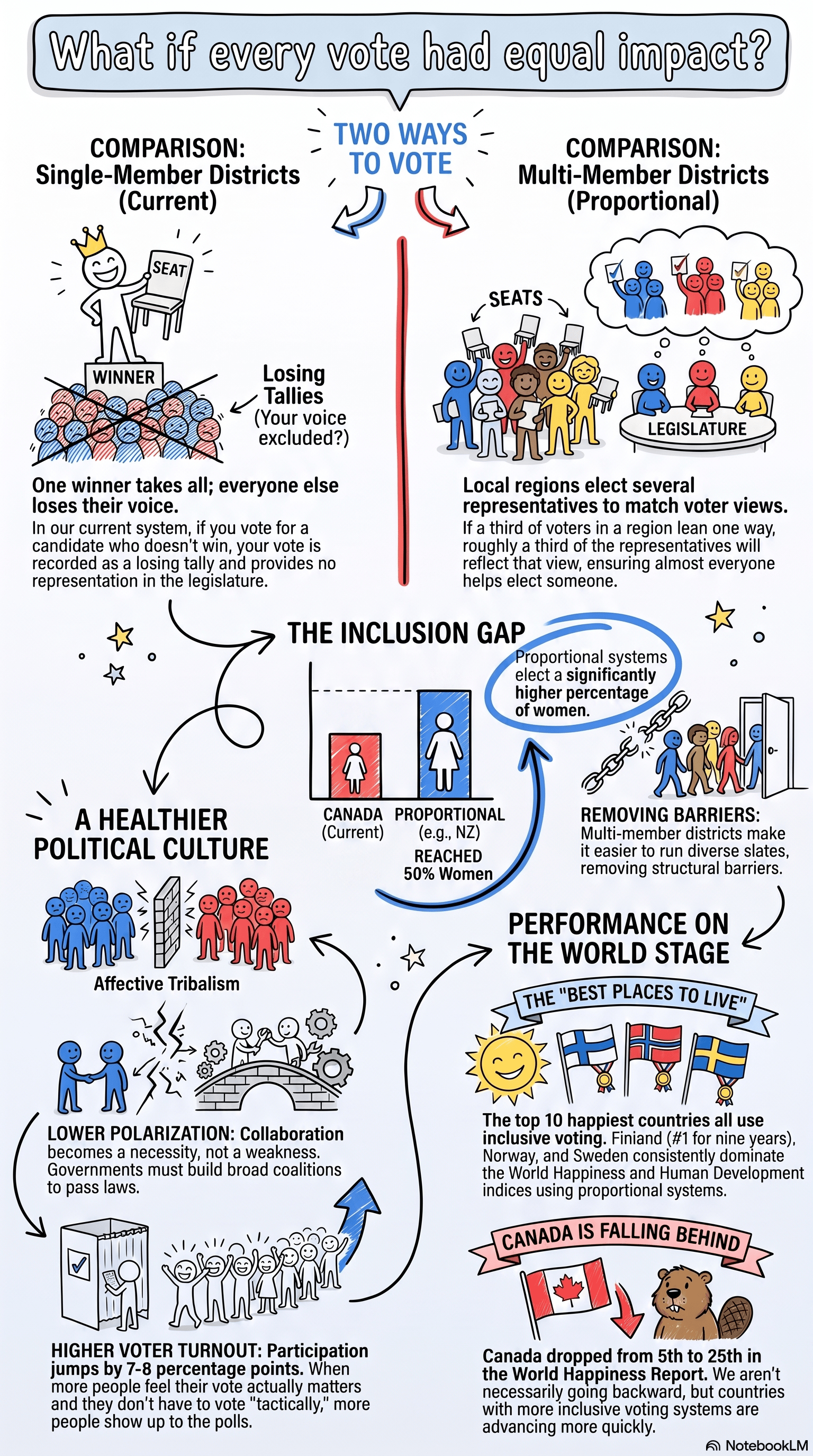
Single-Member Districts …: Under our current system, each riding elects a single winner. If you voted for someone else — no matter how many other voters share your political views — you get no representation at all. Your vote is simply recorded as a losing tally and nothing more.
… vs Multi-Member Districts: A proportional approach works differently. Instead of electing one representative per riding, each local region elects several. The mix of people elected reflects the mix of views voters in that region actually hold. If roughly a third of voters in your region lean one way, roughly a third of your region’s representatives should too. That’s not complicated — it’s just an accurate reflection of how everyone voted.
Representation for All: The result: almost every voter helps elect someone. Your vote contributes to real representation, not just a losing tally. The legislature starts actually looking like the people who elected it.
Consider those currently left out: You may already have a representative who reflects your views. But consider your neighbours — your colleagues, your community — people with different perspectives who currently get little or no voice in the legislature. A democracy that includes more of those voices doesn’t just benefit the people who’ve felt left out. It benefits us all.
Better includes women and minorities: More inclusive voting systems also do a much better job of representing women and minorities. Countries with proportional representation average roughly 31% women in their parliaments, compared to about 17% in winner-take-all systems — a gap of roughly 14 percentage points. New Zealand, which adopted mixed-member proportional representation in 1996, now elects 50% women. Canada, by contrast, sits at just 31% — ranking 71st globally — despite electing its most diverse parliament to date in 2025. This happens because multi-member districts make it easier for parties to run diverse slates and for voters to elect them, removing structural barriers that single-member districts reinforce.
More inclusive policies are better for all: When governments need to earn broader support to pass legislation, they’re less likely to make sharp reversals every election cycle. The political scientist Arend Lijphart, in his landmark study Patterns of Democracy (2012), found that consensus democracies built on proportional representation produce more stable, durable policies than majoritarian systems — without sacrificing effectiveness. When more people feel their vote actually matters, more people participate. Proportional democracies consistently show higher voter turnout (~7-8 percentage points higher), more competitive elections, and governments that must remain responsive to a wider range of citizens — not just their core supporters. And you get to vote for what you actually believe in, not tactically against what you fear most.
Absolutely — and the evidence is clear on this point. Most Canadians, whatever their politics, don’t want our current culture of conflict and political polarization. A 2025 Digital Public Square survey found that 55% of Canadians believe political polarization is getting worse, and two-thirds place themselves near the centre of the political spectrum. The problem isn’t that Canadians are deeply divided — it’s that our voting system rewards parties for acting as if we are, because mobilizing your base against the “other side” is often more effective than finding common ground.
Changed Incentives: Proportional systems change that incentive. When governments must build broader coalitions to govern, collaboration stops being a weakness and starts being a necessity. Somer and McCoy (2018) showed that countries with proportional voting have lower levels of political polarization — less of the “affective tribalism” where we don’t just disagree with the other side, but distrust and dislike them. A more inclusive voting system creates the conditions for a healthier political culture — a bonus on top of the fairer count on election night.
Absolutely not — more inclusive voting systems have a strong track record. More than two-thirds of the world’s democracies already use some form of proportional representation — Germany, New Zealand, Sweden, Norway, Finland, Ireland, and dozens more. These aren’t experiments. They’re mature, stable democracies whose citizens overwhelmingly value the system they have.
Best places to live: They also happen to be among the best places to live on earth. The countries that consistently top the UN Human Development Index — which measures health, education, and standard of living — are overwhelmingly countries with proportional voting systems. The same countries dominate the V-Dem Liberal Democracy Index, the world’s most rigorous measure of democratic health, with Denmark, Norway, and Sweden holding the top three positions. And every single country in the top 10 of the World Happiness Report uses an inclusive voting system — Finland has held the number one spot for nine years running, with Iceland, Denmark, Sweden, and Norway close behind.
Overtaking Canada: Canada used to sit near the top of these rankings. We held first place on the UN Human Development Index through much of the 1990s; we ranked as high as 5th on the World Happiness Report in its early years. Today we sit 16th on the HDI and 25th on the Happiness Report — not because Canada has gone backwards in absolute terms, but because the countries with more inclusive voting systems have been advancing more quickly. That trajectory deserves attention.
Not a magic bullet, but a strong contributor: We’re not claiming proportional voting alone explains everything that makes these societies thrive. But it is hard to ignore that the countries which ensure every voice is heard in their legislatures are also the ones that seem best at solving problems together — and that none of them have chosen to go back. Almost no country that has moved toward more inclusive, representative voting has ever returned to a winner-take-all system. The evidence, and the momentum, point clearly in one direction.
Deeper Dive: If you want to dive deeper into any of this, check out Fair Vote Canada’s Look at the Evidence.
The question we still need to answer:
The case for proportional representation isn’t ideological — it’s practical. Countries where every vote carries equal weight give everyone a stronger stake in society. They consistently produce better outcomes — more representative governments, more stable policy, less polarization, higher voter participation, and stronger performance on the measures that matter most to people’s lives.
Once they’ve started down this path, none of those countries have gone back. Canada is still stuck in the past. We can move in the same direction — but only if enough of us ask the following simple question:
What voting system would help Canada become the best possible version of itself?
Better ways to vote
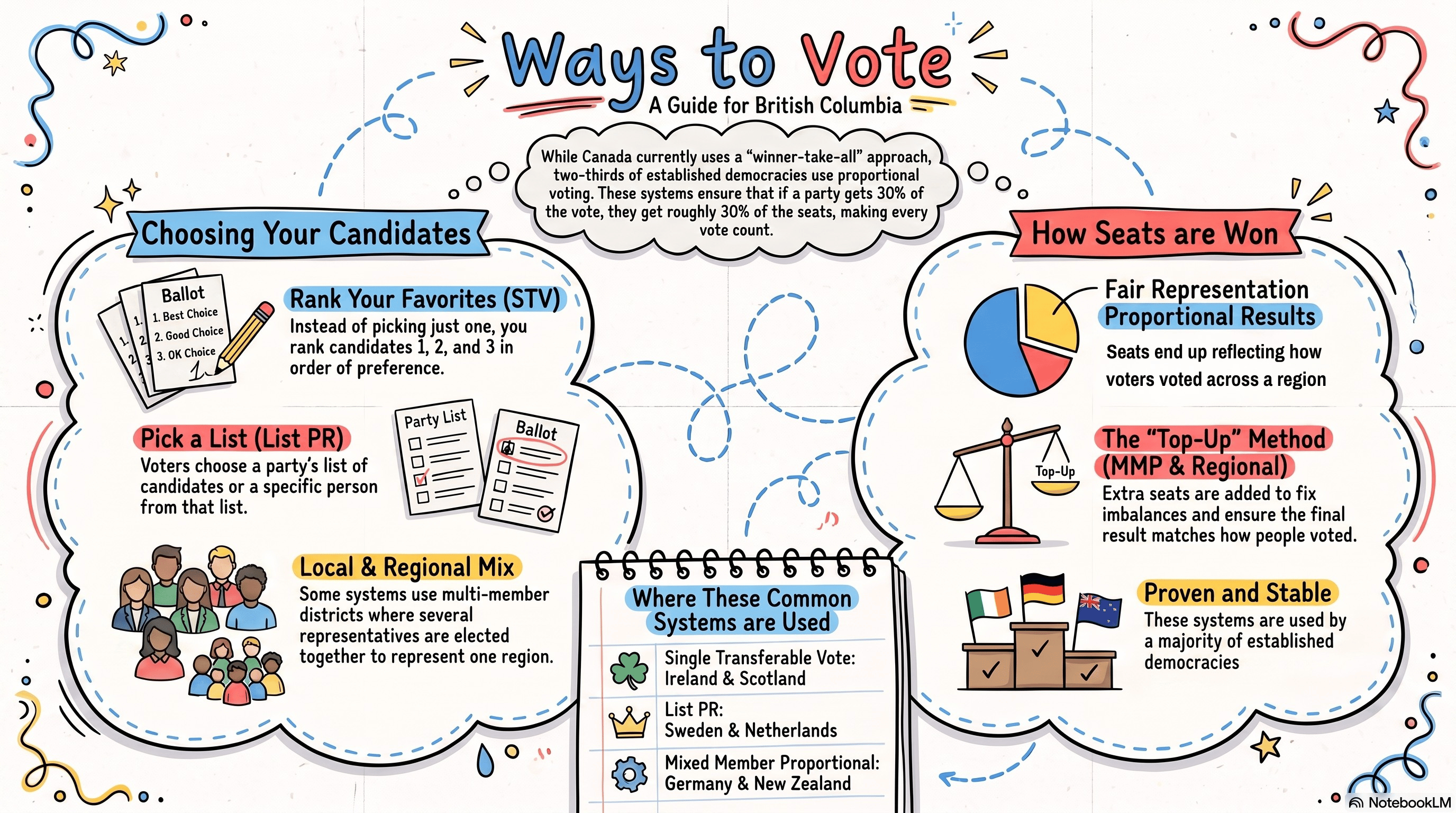
Since we don’t currently use proportional voting here in Canada, people aren’t generally very familiar with it. When they first hear about it, they sometimes assume it’s a new idea or something untested. The reality is almost completely the opposite — Canada is quite an outlier by not using it.
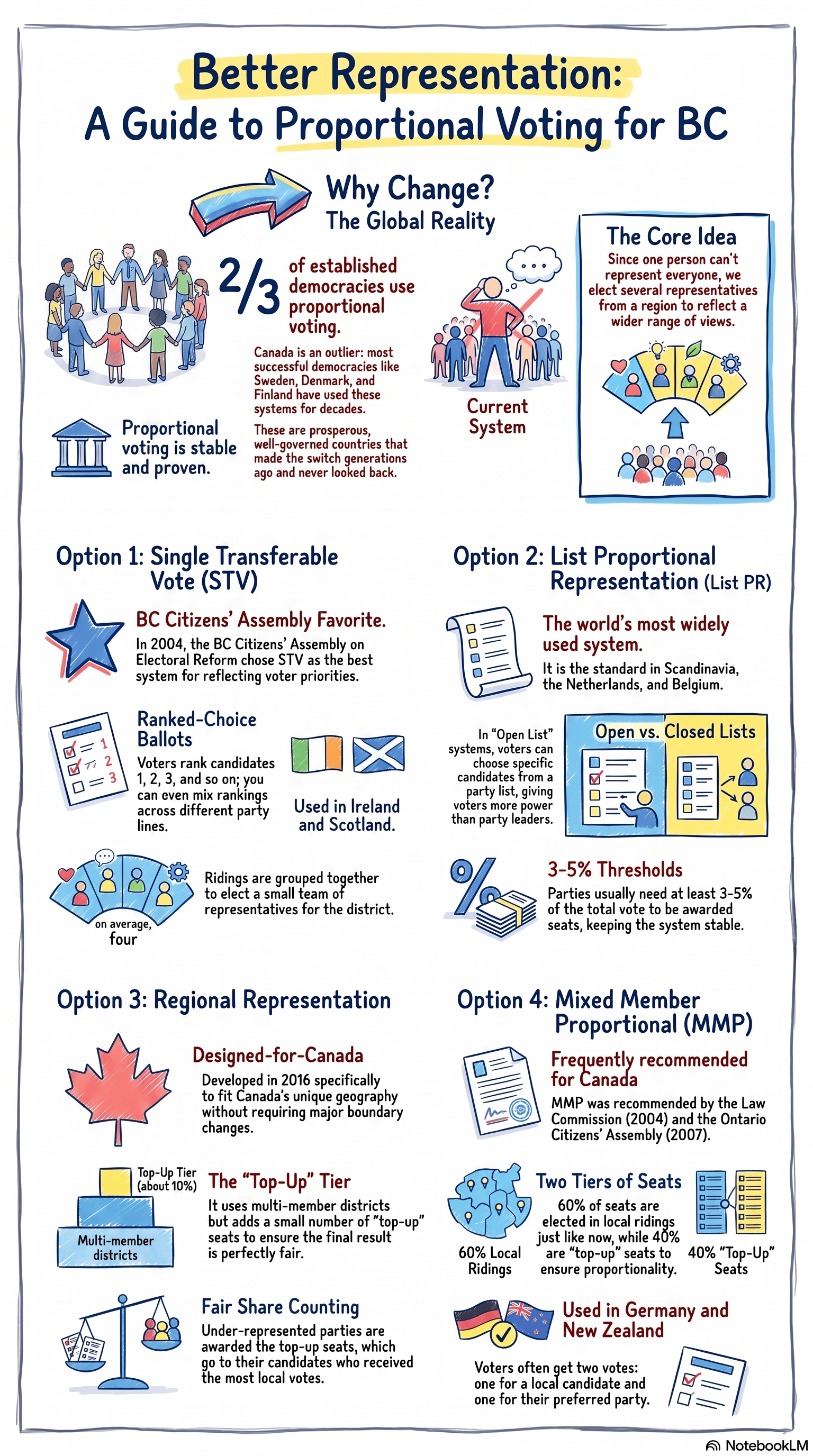
Of the world’s established democracies, roughly two-thirds use some form of proportional voting to elect their national governments. This isn’t an recent trend — most of these systems have been in place, and delivering solid results, for decades. We just don’t hear about them very much.
How proportional voting works, and key options:
The better question is “which don’t?” Ireland. Sweden. Norway. Denmark. Finland. Germany. New Zealand. The Netherlands. Austria. Almost all EU countries. And many others. These are stable, prosperous, well-governed democracies — and they all use proportional systems.
They’re not experimenting. They’re not out of the mainstream. They made this change — in many cases generations ago — and they haven’t looked back.
All more inclusive or proportional systems share one core insight: since a single representative per riding can’t represent the political views of all the voters there, we instead have to elect several representatives together from each region of the province or country.
When several seats are available in a region, almost all voters get to elect someone they actually support, and the overall result closely reflects how people actually voted.
Read on to learn about the main ways this is typically done.
Recommended by the BC Citizens’ Assembly and Used in Ireland and Australian States: The Single Transferable Vote (STV) was the top choice of the BC Citizens’ Assembly on Electoral Reform in 2004 because, in their view, it did the best job of reflecting the priorities of voters.
Multi-Member Districts: STV uses multi-member electoral districts instead of single-member ridings. In Canada’s context, we’d likely group together several current ridings (probably about four, on average) and elect a group of MPs or MLAs to collectively represent the combined electoral district.
Ranked-Choice Ballot: On the ballot, you vote for individual candidates — not just parties. You rank them in order of your preference: 1, 2, 3, and so on. You can rank candidates from the same party, or mix and rank across party lines — your ballot, your choice.
Counting Process: When counting the ballots, candidates who receive a seat’s worth of votes are elected. If your first choice has more votes than they need, the extra support flows to your next choice. If your first choice doesn’t have enough support, your vote goes (“transfers”) to your next choice. Either way, your vote works to help elect a candidate you prefer.
Proportional Result: The result is that the set of MPs or MLAs elected in a district accurately reflect the range of political views there — and you always know exactly which person you helped elect.
List PR is the most widely used proportional voting system in the world. In western countries, it is most strongly associated with Scandinavia, the Netherlands and Belgium.
Multi-Member Districts: As with STV, List PR elects more than one member from each electoral districts. Districts can vary widely in size — from as few as 4 or 5 in Austria or Spain, to an average of roughly a dozen in Finland, Denmark and Belgium, to a high of 150 in the Netherlands and Slovakia. If adopted in Canada, we would likely aim for districts with about 4-5 seats on average.
Ballot Design: Typically, each party presents a list of candidates in each region, and voters are asked to select one of the lists. In many countries — Sweden, Finland, the Netherlands, among others — voters can choose specific candidates from within a party list, not just the party itself. These “open list” systems mean voters can influence who gets elected, rather than accepting the party’s preferred ordering, though the details depend on the system. In Canada, we would likely value prioritizing voters’ choices.
Counting Process: Within each district, the number of votes are counted by party. Each party is then awarded a number of seats in proportion to the number of votes they received. Parties who receive less than a “threshold” amount (typically 3-5% of the vote) are not awarded any seats.
Top-Up Seats: Some countries such as Norway or Sweden also add a small number of compensatory seats — sometimes called adjustment or leveling seats — to make sure the overall result stays proportional even if regional results don’t quite line up. This is a well-established, straightforward approach to making the results align as closely as possible with the voters’ intentions.
Mixed Member Proportional (MMP) is frequently advocated for in Canada. It was recommended by the Law Commission (2004) and the Ontario Citizens’ Assembly (2007), and was on the ballot for the 2016 plebiscite in PEI and the 2018 referendum in BC.
SMDs + Top-Ups: Used in Germany and New Zealand, MMP splits the seats into two tiers: about 60% of the seats would be in single-member ridings and MPs or MLAs would be elected using FPTP, while the balance would be in a “top-up” tier that would compensate for the disproportionality expected in the single-member seats. Each party would submit a list of candidates who would be eligible to be elected in the top-up seats.
Ballot Design: Voters would vote for the candidates in the single-member ridings the same way we do now with FPTP. Optionally, voters are given a second ballot where they can vote for their preferred party (Bavaria allows voters to vote for an individual candidate from the regional list).
Counting the Ballots: The single-member results are calculated the same as FPTP, while the winners of the top-up seats are determined the same way as with List PR — each party’s vote share is calculated (based on the first ballot if a single-ballot system is being used, or from the second ballot otherwise), and a proportional number of seats awarded to each party. The number of single-member seats is subtracted from the proportional totals to determine the number of top-up seats awarded to each party. These seats are then filled in the order shown on the ballot (unless the Bavarian system is being used, in which case the candidate(s) with the most individual votes are elected).
Regional Representation is a “designed-for-Canada” approach that combines the multi-member districts of STV or List PR with a small top-up, or compensatory, tier. It was developed by Byron Weber-Becker (University of Waterloo) and Antony Hodgson (Fair Voting BC) at the request of the federal Electoral Reform Commission in 2016 to address certain questions the committee had (such as whether a new system would require boundary changes — spoiler alert: they don’t).
Multi-Member Districts: As with STV or List PR, we’d likely use multi-member districts of moderate size — likely averaging about four members. These would be grouped into regions of 12-20 seats, with 1-2 top-up seats added (~10% of all seats).
Ballot Design: The ballots would typically be identical to either those used with STV or Open List PR — voters would either rank or indicate their preferred choice.
Counting : Counting would proceed in each electoral district the same way as under STV or Open List PR. In addition, we would total each party’s vote share across the region and determine what their fair share of seats would be (counting the top-up seat(s)). The most under-represented parties would be awarded the top-up seats, and they would go to the candidate(s) from those parties who had received the greatest number of votes, but were not elected in their local regions.
Proportional Result: As with STV and Open List PR, the set of MPs or MLAs elected in a district would accurately reflect the range of political views there, and the small number of top-up seats would reduce the barriers to voters with minority political views electing an MP or MLA who shared their views and would ensure that the overall seat totals accurately reflected the regional results.
Fair Vote Canada has prepared a number of useful tutorials on various voting systems. Check them out below:
Proportional voting is proven. Now it’s our turn to get on board.
The benefits of proportional voting aren’t theoretical — the evidence is sitting right there in the election results of dozens of countries. Proportional voting works, it’s stable, and it makes democracy more representative.