We were thrilled with the response to our first ‘E-volving Democracy’ dialogue event held in Vancouver on May 26th. Over thirty passionate voters, including computer security specialists, lawyers, social activists, business owners and many others, spent a gorgeous sunny Saturday inside, hearing from our panelists and working out what it would take to convince them personally to accept online voting as a legitimate and safe way to hold online elections. We’re working to put out a report on this event, but the three main messages were clear:
- very few people thought that the absence of online voting was a major cause of decreasing voter turnout (one person asked, “what is the question for which online voting is the answer?”),
- virtually everyone thought that any new election process should retain the key feature of our present process that creates widespread trust in the results – namely, that ordinary people can act as scrutineers for all candidates, which ensures that even the losing candidates can accept the results, and
- participants were most excited about the possibility of using online processes to increase democratic engagement between elections (e.g., to formulate public policy). Check out yesterday’s New York Times story on this.
Since current expert opinion seems to be that online voting can’t be made acceptably secure in the foreseeable future, Fair Voting BC will likely seek an endorsement from our members at our upcoming Annual General Meeting in the fall to adopt an explicit position on internet voting cautioning against use in public elections and calling for governments to pilot new internet-enabled public engagement processes. In the meantime,
please take our latest poll to tell us what you’re currently thinking about online voting.
94% of FVBC Supporters Endorse Change to Voting System Prior to 2013 Election
Last month, we asked you if you would support the BC Liberals if they opted to implement a new voting system in time for the 2013 provincial election. Over a hundred of you registered your opinion, and we were intrigued to see that 94% of you would be in favour of such a move, even if the Liberals might win more seats under a more proportional voting system than they are
currently predicted to win. This near-unanimous support is particularly impressive because, since FVBC’s supporters come from across the political spectrum, a substantial number of non-Liberal supporters amongst our poll’s respondents must feel that a result that is less favourable to their own preferred party is nonetheless fairer than what our Single Member Plurality voting system is predicted to produce. We strongly commend such a principled stance on the part of our supporters.
Disappointing Result From Quebec Court Challenge to Single Member Plurality Voting
Crowd-Sourcing a Constitution?

No, not Canada’s. Iceland’s. In the wake of Iceland’s economic meltdown four years ago, its citizens have reasserted control over their key democratic institutions. In late 2010, a group of 25 Icelandic citizens were elected to a Constitutional Assembly (using STV!) and, last summer, following an extensive public engagement process involving considerable use of online tools,
they submitted a new proposed constitution that emphasizes three major themes:
distribution of power, transparency and responsibility. Among numerous democratic innovations, the proposed constitution calls for measures that will increase consultation between groups represented in parliament, public rights to initiate legislation (by petition of 2% of voters) and hold referenda (by petition of 10% of voters), and a novel electoral proposal that allows voters to select individual candidates across constituency and national lists. The new constitution was originally due to be voted on in a referendum this week (June 30th), but
the vote has since been delayed to the fall.
Two Swords’ Length Apart No Longer? Improving Decorum in the Commons

If former NDP (now independent) MP Bruce Hyer has his private member’s bill approved, MPs will stop sitting by party in the House of Commons, but will instead be randomly intermixed with MPs from other parties and regions of Canada.
According to the CBC, Hyer, “who is now free to speak and vote as he wishes, thinks the move would end the “mindless solidarity and tribalism” he sees around him and improve cooperation and decorum.” 75% of respondents to a CBC poll thought that Hyer’s proposal was worth a try. “”It’s very hard to heckle someone or be rude to them when you’re sitting next to them,” Hyer suggested.”
A National Post article said “Mr. Hyer said the partisanship over the omnibus budget bill reached new lows. “The mindless tribalism has always bothered me, but never more so than [Thursday] night. Most of those on the other side have never read C-38 or the opposition amendments. It’s difficult to believe that of the 800 or so amendments, not one deserved consideration.””
Since stepping down from the NDP earlier in the year after voting with the government on the long gun registry, Mr. Hyer has been on a campaign to enhance the independence of MPs. Yesterday,
a Winnipeg Free Press article entitled “An MP Who Can Think for Himself” noted that he was the only MP to take Elizabeth May’s challenge of a quiz on Bill C38 and, with a perfect score, proved that he had actually read the whole bill.
Image attribution: Rrius at en.wikipediaA Rare and Raw Look at How Party Discipline Actually Works

Last month, BC Conservative MP David Wilks (Kootenay-Columbia) gave Canadians a rare, raw and candid glimpse into how modern party machines work. Wilks told his constituents he had serious concerns about C-38, the recently-passed omnibus budget-implementation bill. According to
a Winnipeg Free Press story, Wilks “noted he doesn’t get to see the budget until the public does. The prime minister and cabinet go into a room and make all the decisions, and the rest of the caucus gets told how to vote. Wilks was frank about the fact there are [whipped votes]” and the insignificance of the role of the backbencher MP. Although in principle there are occasions “when caucus members can vote however they want, … that … kind of vote is a mystery to him. “I haven’t seen one in a year, yet,” he said. Since being sworn in as an MP in May 2011, Wilks has never been told by his party whip he can vote on his own.”
As
Andrew Coyne reported, Wilks said that “if a dozen other Tories could be persuaded to vote against it, he would do likewise. “I will stand up and say the Harper government should get rid of Bill C-38.” [But] within hours of the video’s appearance, Wilks had recanted.” Coyne goes on to discuss what this episode teaches us about how the role of MPs has changed in the past couple of decades, while
Dan Leger laments Wilks’ loss of courage: “The tragedy is that Wilks denied himself the chance to actually be somebody through the simple act of representing his constituents.”
We’re #51! (International Hall of Shame)

According to
a recent Canadian Press story, “As the 30th anniversary of the federal Access to Information Act approaches, Canada finds itself tied for 51st in the world on a list of freedom-of-information rankings, languishing behind Angola, Colombia and Niger.”
The news gets worse – we’ve dropped 11 places on the scale since last September!
The index was co-developed by two international human rights organizations – the Halifax-based Centre for Law and Democracy and the Madrid-based Access Info Europe. They comment “As a country that was once among the world’s leaders in government openness, it is unfortunate that Canada has dropped so far down the list*. Partly, this is the result of global progress, with which Canada has failed to keep pace. Canada’s Access to Information Act, while cutting edge in 1983, has not been significantly updated since then, and reflects many outdated norms. Canada’s lax timelines, imposition of access fees, lack of a proper public interest override, and blanket exemptions for certain political offices all contravene international standards for the right of access. Canada’s antiquated approach to access to information is also the result of a lack of political will to improve the situation.”
 Canada Day Petition Challenge
Our good friends at Fair Vote Canada are co-ordinating a Canada Day petition drive and are asking for volunteers to help collect as many signatures as possible in favour of proportional representation so that they can deliver petitions to as many MPs as possible in a co-ordinated Day of Action later in the summer. If you think you could get at least 25 people to sign this petition, please consider making this part of your Canada Day festivities.
Click here to download a petition page and to get more information.
Yours for a stronger democracy,
Antony Hodgson
President, Fair Voting BC
PS: Election Humour – Chocolate Wins ‘Best Flavour of Ice-Cream’ Election

Check out this great press release from
OpaVote, creators of open-source online voting software for use by organizations:
Just in time for the start of the summer season, OpaVote has determined that Chocolate is the universe’s favorite ice cream flavor.
After a hotly contested race and four rounds of counting, Chocolate scooped the victory by soundly defeating the runner up, Chocolate Chip. Other flavors that melted under pressure were Vanilla, Strawberry, and Cookies and Cream. Click here for complete results.
Chocolate declared victory at 11:32 pm on the summer solstice, thanking his opponents for a tasteful campaign and promising to provide a summer of chockingly great ice cream.
Chocolate Chip conceded victory and commended the use of ranked-choice voting as representing the will of the people. “Although I did not win, it is clear that the majority of the people preferred Chocolate and she should be the winner,” said Chocolate Chip. “The use of ranked-choice voting prevents fringe candidates, like Strawberry, from acting as spoilers and undermining the will of the people.”
Vanilla complained bitterly. “Special interests bought this election,” said Vanilla. “We need meaningful campaign finance reform to prevent the cocoa industry from using their campaign war chests to get their puppet candidates in office to increase their own profits at the expense of democracy.” Hershey and Cadbury declined to comment.
To run your own election or poll, click OpaVote. You can run an election with up to one million voters where each voter is sent a secret voting link. You can also run a poll and embed a poll widget in your own website.


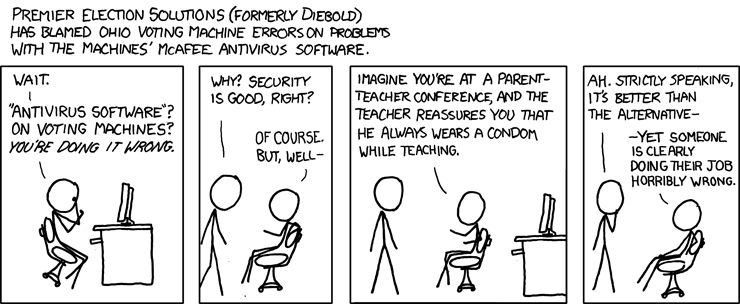


 As if one robocall scandal weren’t enough, the
  In more local news,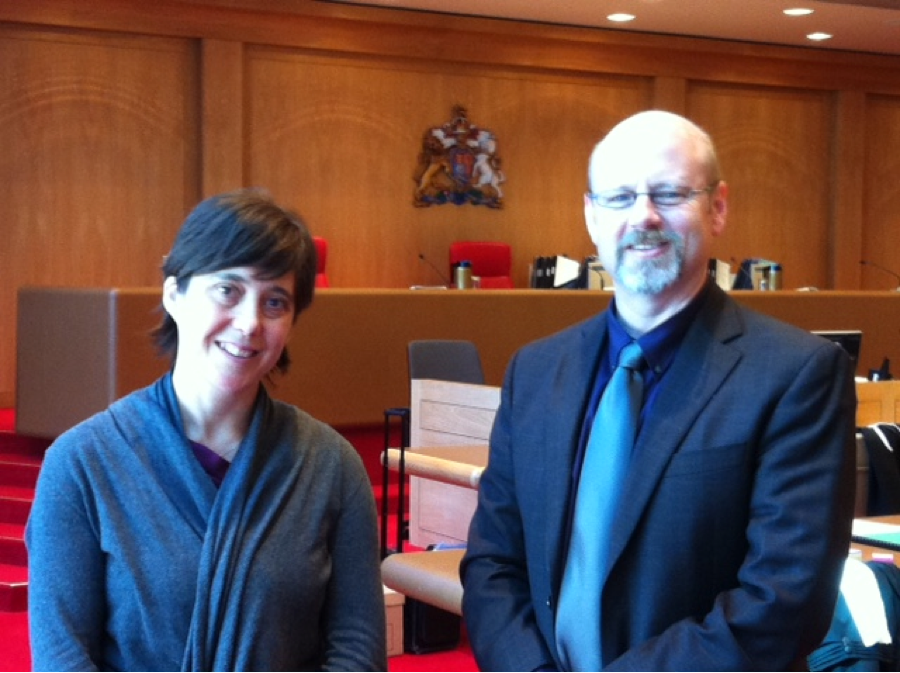
 We are particularly excited to let you know that we’ve confirmed the date for our second E-volving Democracy Dialogue which will be held on Saturday, October 27th in Vancouver (likely 2-4:30pm). The topic will be ‘Engaging Citizens’, and we’ll be looking at some fascinating models for giving people more meaningful ways to get involved in political processes. We expect to have speakers from the
  Meanwhile, the leader of the Green Party, Elizabeth May, is proposing not to run a Green candidate in a by-election, and she is encouraging the NDP to do the same. May’s argument here is that voters should have a clear choice between the two front-runners in this by-election so that their wishes can be clearly determined. But is this democratic? At the heart of the problem is that our current voting system does not enable us to vote honestly and win representation that reflects how voters vote.
 A BC donor who was recently found to have made a prohibited political donation justified it by saying “It’s a cost-effective, time-effective way to interact with the people in the government. That’s the way the system works…This is really how the world works.” IntegrityBC would like to end this form of privileged access. If you agree, please consider
 Many of you will recall that the


 This weekend Thomas Mulcair was elected the new leader of the federal NDP and therefore of the Official Opposition. We are pleased that Mulcair has said that moving to a mixed-member proportional system will be a fundamental plank of the New Democratic Party’s platform next election: “Canadians are well aware of the pitfalls of our electoral system. They agree with us that change is needed. When we get elected, we will get elected with a strong mandate to address those shortcomings. If needed, we will cooperate with other parties in the House of Commons and the Senate in order to make electoral reform a reality.” We urge electoral reform supporters to hold the NDP to account moving forward.
 As Elections Canada digs deeper into the voter suppression tactics employed in the last federal election (largely against Liberal supporters), we are reminded that the main reason such tactics can be effective is because of the pathological sensitivity of our current Single Member Plurality voting system to small manipulations of votes. With SMP, numerous ridings are typically won by vanishingly small numbers of votes (e.g., Jay Aspin won by only 14 votes in Nipissing and Ted Opitz by just 26 votes in Etobicoke Centre). Adding these up, we find that barely
  BC Liberal MLA John Les (Chilliwack) this month
  In the wake of last week’s filing of financial disclosure statements by Vancouver’s civic parties, showing that donations were up 50% from 2008 (from just under $4M then to just under $6M last year), including a single corporate donation of nearly $1M, Minister Ida Chong has said she won’t implement the request from Vancouver City Council to limit personal donations or ban union, corporate and foreign donations.


 PEI went to the polls in early October. The Liberals went into this election with a large lead – polls at the end of August were giving them a lead over the Conservatives of 59% to 31% (with the Greens and NDP splitting the last 10%) and, had this support held up, they certainly would have deserved to win a majority government. But would they have been entitled to win every last seat in the PEI legislature?
  In
In 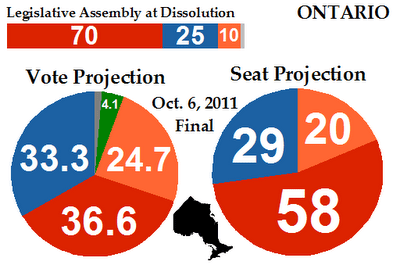 The Ontario election in October produced a similar result – the day before the election, ThreeHundredEight.com was predicting that the popular vote was a solid three-way contest with the Liberals slightly ahead of the Conservatives (36.6% to 33.3%), but this small difference was expected to deliver twice as many seats to the Liberals than to the Conservatives. The NDP, with 2/3rds the popular support of the leading Liberals, were expected to win barely one third as many seats. In the end, the Liberals ended up at over 37%, the Conservatives about 2% lower at just over 35%, and the NDP down to under 23%; the Liberals won one seat shy of a majority at 53 seats and the Conservatives gained ground to win 37 seats (the NDP took 17). This seat distribution corresponds somewhat more closely to the
  parties’ vote shares than originally predicted, but the Liberals still gained a significantly disproportional advantage from how the votes were distributed. As in Manitoba, the results reflected a strong regional divide, with the Conservatives sweeping several rural regions and the Liberals taking a disproportionate number of the seats in the Greater Toronto Area.
 Fair Voting BC